Showing posts with label christopher nolan. Show all posts

Interstellar (2014): or how I learned to suspend my disbelief and love movies

I've always been a big fan of Christopher Nolan, ever since Memento, which was among the earliest movie I reviewed here. Batman Begins, The Dark Knight and The Prestige are also in my list of personal favourites, and that is due to one reason; the motivation of the characters in those movies are believable. Things don't happen just so that the plot can be advanced. I've also written about this. To a certain extent, I've also adopted the same notion in other mediums of art I enjoy, that's why I consider HBO's The Wire as my favourite TV show of all time, and enjoy George RR Martin's A Song of Ice and Fire fantasy novel series; the characters are calculating and they do not make decisions that make the viewers/readers question the validity. These Nolan movies left me thinking about them a few days afterwards, trying to poke holes and find inconsistencies in them. Usually when I found one (Batman won't kill bad guys, but letting Ras Al Ghul plunge to his apparent death on the runaway train is ok?), it did not matter much because they are just minor things and they are overwhelmed by just how enjoyable the rest of the movie is.

(By the way, the reason Gandalf and the Fellowhip do not take the Eagles from the very beginning is because there are Nazguls and dragons.)

This means that it often detracts my enjoyment of certain movies. I do understand that works of art often need to take certain liberties with things such as realism, physics and politics and employ fantastical elements, but I've become too eager to pick holes in said movies. Let's take the example of those Marvel superhero movies. I do enjoy them, but only to a certain extent. I can't get past why Iron Man only needs his basic suit to take out hordes of Chitauri spacecrafts, but needs to wear another armour over his basic armour in order to take on Hulk. That's why I don't really care for Thor, because his movies sit in the magical realm, although they do try to explain it away as very advanced science, which to our relatively primitive civilisation, appears magical.

That's not to say I'm a total logic monster. When it comes to watching comedies and musicals, I am more pliant. My shield just goes up when I watch drama, thriller or any 'serious' movies.

And that is why I didn't mention his other movies above; The Dark Knight Rises and the very popular Inception. I was massively disappointed with TDKR, because there are just so many plot holes in it. Gordon brings his confession note everywhere, later conveniently found by Bane who uses it to demotivate the city residents? Batman simply believes a female criminal who dresses up like a cat, who then walks him right into Bane's trap? Almost all of Gotham's police force is taken to conduct a raid, only to be trapped underground, leaving the city defenseless, and when they are eventually released, they confront Bane's thugs in hand-to-hand combat, in broad daylight? How the hell did Batman manage to get back to Gotham, and sneak into the isolated and barricaded city? If I found more holes, the movie would turn into a documentary about cheese instead.

Whereas with Inception, the problem is not so much with the plot, which I think was more or less watertight for a movie with its scope, but with me not being able to enjoy it. It was just 'meh'. I didn't go home trying to work out what the inconsistencies were.

Naturally, when Nolan's latest movie, Interstellar was announced, I was equal parts excited and wary. It did look exciting with a hefty science fiction subject matter that involves space travel and time, but movies that employ these two usually end up with numerous plot holes. I wondered whether this movie would go the same route as TDKR. Maybe TDKR and Inception were not glitches.

[SPOILERS] After watching Interstellar last week, my take on it is that it does have a few plot holes: the sudden inability of a smart physicist in calculating the time dilation on the first planet, how Cooper manages to come through the other side of the black hole, that sudden talk about love nonsense, how Murphy manages to convince her very angry brother that their father is actually talking to her from wherever he is, and who are 'they' actually?

However, I think this is the first time whereby plot holes in a movie does not affect my enjoyment of it. I thoroughly enjoyed every second of it, and it convinced me that the holes are necessary for me to enjoy it. I cried three times at least, and it made me feel the vastness of our universe and comparatively, how infinitesimal we are.

Interstellar also reminded me again how a movie can use the fantastic to make us forget the world beyond the four walls of the cinema, for the duration of the movie. Just like his earliest movies, I spent the following day just asking questions about the movie's plot, and I did find a few things (which I raised above), but they ultimately don't matter. It managed to sweep me to a different state of mind.

I'm not gonna review the movie because I'm sure other people have done it better than I can. But you should go watch it, the visuals are impressive, the plot arresting and best off all, all this is used to speak about the bigger picture; humanity. The science fiction elements are merely vehicle to tell the story of humanity and our place in the universe.

The GOOD: Bittersweet and heartbreaking theme, beautiful visuals, brilliant execution, spot-on performance, and TARS.
The BAD: That hammy love vs science speech that comes out of nowhere, repeated quoting of Dylan Thomas' "Do not go gentle into that good night".
My VERDICT: 8/10. Far from perfect, but highly enjoyable and mindblowing in more ways than one.
TRIVIA: Matthew Mcconaughey once starred in another movie about interstellar travel, Contact (1997) as a priest.

I want good character-motivation

After all these years, I've only watched Crouching Tiger, Hidden Dragon last night. The movie is great, the cinematography beautiful, and the action scenes are simply mindblowing, especially the fight scene on the bamboo plants. However, what makes it brilliant is how the director; Ang Lee uses all those kung fu and action scenes to tell a very poignant story about what essentially are very human desires and longing. But I'm not writing today to review this movie. After all it's rather accessible, and a lot of reviews have been written about it. That's not what I intend to do in this blog.

I want to talk about a notion that I have always had, that I think was finally confirmed upon watching Crouching Tiger. I have my own list of what I consider my personal favourites, and I've always thought that they share one similarity; believable character motivation that is propelled by believable emotions. What are these movies? Saving Private Ryan, Lord of the Rings, Memento, Batman Begins, The Matrix, Eternal Sunshine of the Spotless Mind, Songlap. I know, these are quite popular movies, nothing too art-housey nor obscure. I'm not gonna lie, I enjoy watching giant robots punch each other to pieces, and digital messiahs stop bullets with a wave of his hand in blockbuster movies as much as the next guy. But for these movies to transcend their status as mere explosion-fests, to attain immortality and occupy their place as my favourites, takes a lot more. And that is their strong emotional core. This essentially means that in these movies, the characters' actions are motivated by the sort of feelings that are relatable to the audience. Whatever the actions taken by them on the screen are, they make us go "I guess I'd put on a bat costume, leap off buildings, and bash criminals' heads in too, if I were a billionaire whose parents were murdered by a mugger". Let's begin with...'Batman Begins', haha. 

It would be too far a leap if the story has Bruce Wayne put on a bat costume to fight crime straightaway, but the story gains legitimacy by having him try to exact revenge on his parents' murderer first. And the movie (or the source material, I don't read a lot of comic books) then has it that someone else gets to the murderer first, depriving him of that one thing that he thinks is going to let him sleep more peacefully at night. And then his childhood sweetheart gets disappointed at him for wanting to exact revenge, saying that his dead parents would be equally disappointed of him. He's a boy whose parents will not be there anymore to comfort when he has nightmares, and his only chance at some semblance of happiness or satisfaction is taken away from him. On top of that, his girlfriend is upset at him. He's all alone in this world. ONLY THEN the batsuit, batmobile, and gadgets feature in the movies. 

And even then the movie doesn't ditch its emotional core. He becomes Batman at night to ensure that no one has to suffer what he had gone through, but far from it being done just out of selflessness, he also does it out of a very personal need to silence the screams of his murdered parents that he hears every night (comic book fans have said that Batman is actually just as crazy as the villains he battles). What's worse is at the end, upon defeating his enemies and revealing to his sweetheart that he is Batman; she rebuffs him, saying that the boy she knew never came back from his soul-searching sojourn halfway across the world, instead in his place now is a man whose sole interest is fighting crimes with his various bat-themed gadgets. He is still all alone, save for the company of his loyal butler.

Yeah, yeah I know. I can be a bit obsessive about Batman and Nolan.

How about Saving Private Ryan? At the end, the mild-mannered squad captain, played by Tom Hanks (he doesn't play any other kind of character, does he?) reveals that he willingly risks his life to take up the job of rescuing Private Ryan's life in order to atone for the killings he has committed throughout the war, in order to 'deserve' coming back home to his wife and previous life. And he also tells Ryan to "earn" being rescued at the cost of the squad's lives, after his tour of duty ends. These are all very real motivations that the audience can relate to.

In Memento (another Nolan fare), Leonard the amnesiac protagonist goes around looking for his wife's murderer despite his handicap, not just for revenge, but also to fill the void in his now empty life, and the ending of the movie makes this need even more apparent.

In the Lord of the Rings, why does Frodo make the perilous journey to Mt Doom to destroy his uncle's ring? It's definitely not because he wants to save the Shire, or protect Middle-Earth. He is just one of the Hobbits, a race who is insequential in the wars and history of the bigger and more noble races of Middle-Earth. It is because he has been told by Gandalf that Sauron and his agents will keep coming for him for as long the ring is in his possession, putting his own life in constant mortal danger. All the big talks about loyalty, responsibility, duty and sacrifice in the trilogy come from Sam, Gandalf and Aragorn, if you pay close attention.

How about in 'Eternal Sunshine'? Without revealing too much, it's not just about a guy who loses his love, but it's about not wanting to let go of the memory of that love, even the bad times.

These are all very relatable emotions that are not easy cop outs in any movie. I mean the desire for revenge at a loved one's death is not too far-fetched, but how often do we go on bullet-spraying vendettas after a family member dies after being hit by a drunk driver in real life? Sure, in most movies true love waits or stands outside the room with a boombox (or stalks behind the bushes with a meat cleaver in horror movies), but in real life we just find ourselves a new partner sooner or later, no matter how painful the heartbreak is initially. These are not very relatable emotions that inspire credible motivations for the audience to start suspending their disbelief.

Don't get me wrong. I concur that movies are ultimately just our escape from reality, but for me, that flight into fantasy must be grounded in reality at its heart, if a movie wants to be really great. Think of CGI, they say that it's just a tool in the arsenal of a great movie-maker, but it must never supersede or replace good storytelling itself. The same can be said about character emotions and motivations. You can make a cerebral thriller that twists and turns unexpectedly at every corner to enthrall the audience, but if you don't give the hero a relatable motivation, it will end up just a good movie, not great. All the actions taken in the thriller are just there to advance the plot.

In the case of Crouching Tiger, I love how the imaginative fight sequences are just the icing on a well-written cake of a movie that's peopled by characters that are simply looking for their own happiness, after having distanced themselves from the affection of another human being after all these years due to honour and self-sacrifice.

To further solidify my point, I'll take the example of another Batman movie that was also directed by Nolan; 'The Dark Knight'. It is essentially structured as a caper story, and a pretty smart one at that. It is a great movie, but it is not one of my personal favourites. Why? It's because I feel that it loses some of its emotional core, and instead of being driven by character flaws as in Begins, Dark Knight is advanced by idealism and stoicism. For me, that's not real and it doesn't grip my emotions. I think realistically, we as humans are more weak in character than we are strong, and from our smallest and most mundane daily actions, to our civilisation, are shaped and motivated by our weaknesses as very emotional creatures, instead of our courage and selflessness.

However, I admit that some movies, such is in the case of the Matrix, are simply great because of their inventiveness, the cool factor. Keanu Reeves is the last guy you'd approach to play characters with emotional depth and nuance; and I sure as hell wasn't emotionally affected when I watched the Matrix. The bullet-time, shades, trench-coats, wire-fu in the movie are very imaginative and cool to the point that it's in my personal list without even having to appeal to my emotions. But it's a rarity. I still want good character motivation.

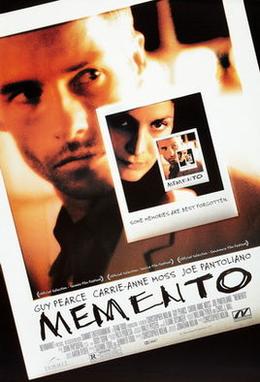
Memento (2000)


My second review for my blog is on one of my personal favourite movies of all time by my favourite director; Christopher Nolan. Yup, he's the guy who directed the two Batman movies and whose new movie, 'Inception' is coming out sometime this year. However, this movie came out before he made it big in Hollywood and upon viewing, you could see how hassle-free it seems to have been made, production-wise. No big 'splosions, no crowd-pulling A-listers, just a pure solid story. And that's why I love his movies; he is equally adept at handling high-budget blockbuster flicks as he was with low budget, location-shot movies. But I'm being a bit of a fan boy here so let's get back to 'Memento'.

This movie tells the story of Leonard Shelby (Guy Pearce), a short-term memory loss amnesiac former insurance-claims investigator who, despite his condition, goes in search of the man who causes his amnesia and also his wife's death in a house break-in. Given his condition, he extensively takes notes and photographs in the course of his investigation and he is particularly suspicious of people. Despite his mistrust in people, two seemingly helpful characters pay special attention on him and also help him in his pursuit. Now what's mind-blowing about this movie is that it is told out of sequence, with things that happen chronologically in the end are put at the beginning the movie and as the movie progresses, we are essentially also moving closer towards the beginning of the chronological story. And at the same time, a subplot is also spliced into the movie in a linear order, making the story disorienting, but not in a bad way. In the end, these two plots will merge in such a powerful way that you would have to watch it again to understand because by the end; your understanding of the plot, the characters, everything would have been turned on its head. And trust me, when it comes to Christopher Nolan's movies, you would actually want to watch it over and over again. And for me, one indication that a movie is exceptional is when you keep coming back to revisit it from time to time.

I'm refraining myself from saying that everything about this movie is GOOD so I'll try to be a bit more detailed:
1) the script is solid and water tight and there are almost no plot-holes that Chris Nolan's detractors can use as ammo;
2) it's use of perfectly-timed humour. Given that this is quite a heavy movie, Christopher Nolan was careful in using homour to lighten up the mood just a teeny weeny bit. It's not that there's a lot of it in 'Memento, but when it's there, it's when it is very much needed and used sparingly, just the right amount. In my humble opinion, solid scripts and intelligent use of humor are among Nolan's strongest points and also his trademarks.

The BAD: seriously I can't think of any. Apart from it being a little confusing at times. But it's nothing that someone with an average level of intelligence can't handle.

So my VERDICT for this movie is... 9.5/10! 'Memento' is an exceptional early movie from Nolan that introduces all movie-goers to his masterful handling of brilliant yet at-times convoluted stories that would otherwise have dissipated in other less-capable hands.

MOVIE TRIVIA: Joe Pantoliano and Carrie-Anne Moss who star in this movie had previously worked together in 'The Matrix'. I wonder why Nolan didn't cast Keanu Reeves as Leonard, since he was already doing that with the two?


P/S: Now I remember. Keanu Reeves can't act to save his life.